
Show summary Hide summary
Severe storms across the Southeast forced multiple college football games to pause or shift channels on Saturday, disrupting broadcasts and stadium schedules. High-profile matchups including Clemson–North Carolina and Florida State–Alabama were among those delayed, prompting network reschedules and extended on-field stoppages.
Games stretched into multi-hour events
Clemson’s late comeback against North Carolina turned into an hours-long affair after a roughly 2½-hour weather delay struck midway through the fourth quarter. The game began on ESPN but finished on the affiliate channel ESPNews, while ESPN substituted the time slot with Kentucky–Texas A&M, which kicked off at 3:30 p.m. ET.
NCAA files suit contesting Ohio governor’s order on fifth-year eligibility
Wisconsin’s homecoming matchup with Michigan State: three predictions
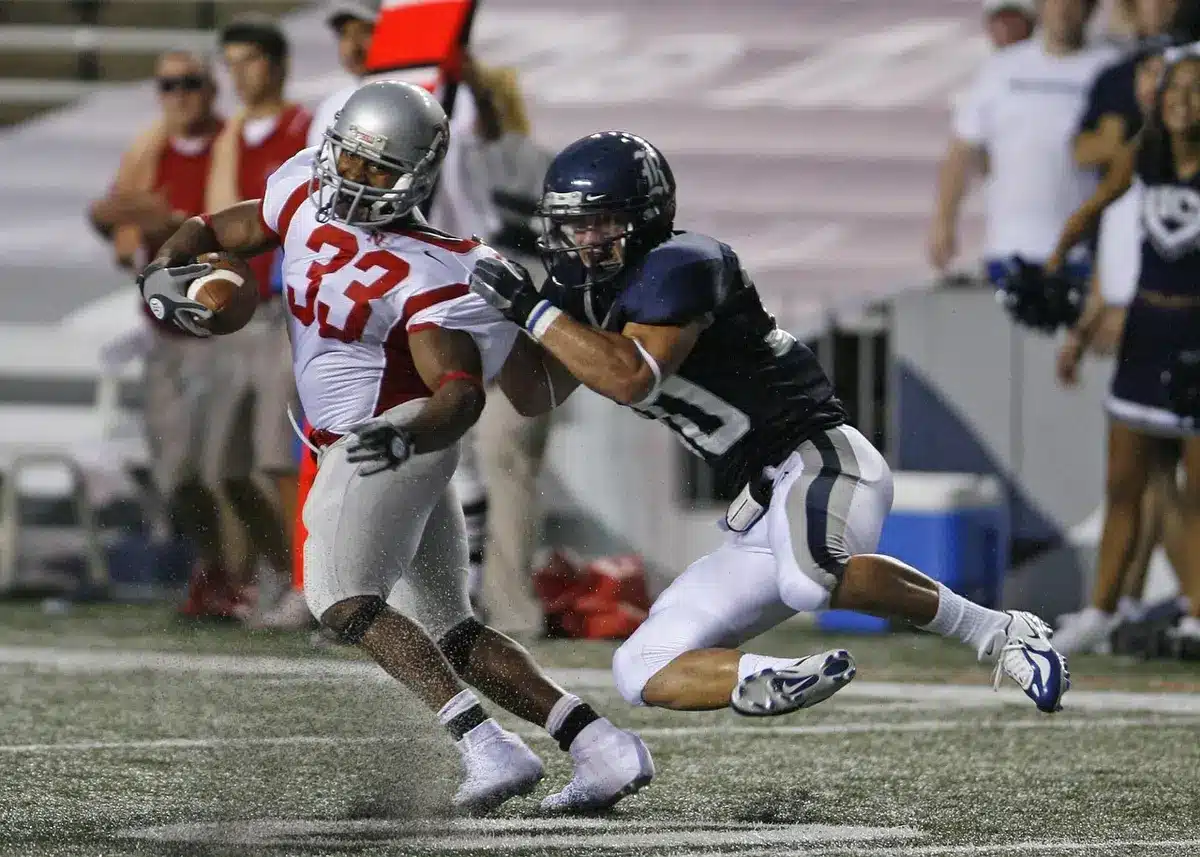
At another site, Mississippi State–South Carolina faced a delayed kickoff after a one hour and twenty minute stoppage, and BYU–Colorado State was pushed back by about one hour and fifteen minutes from its scheduled 8:15 p.m. ET start.
Florida State–Alabama moved across networks
ABC’s planned 3:30 p.m. ET kickoff between Florida State and Alabama experienced two separate interruptions: an early pregame delay that pushed the start nearly two hours and a later 30-minute stoppage with 2:36 remaining in the second quarter. To accommodate the schedule, the game was shifted to ESPN2.
The channel change made room for the primetime LSU–Ole Miss matchup, which began shortly before 8 p.m. ET. Meanwhile, Florida State–Alabama’s slot displaced New Mexico–Oklahoma to ESPNews and the ESPN App; broadcasters said New Mexico–Oklahoma would return to ESPN2 once the Alabama–Florida State game concluded.
Social posts from the scene showed lightning in the area, a common cause for lengthy pauses during storms.
How officials decide when to stop play
All affected contests followed the sport’s lightning protocols. Under standard NCAA policy, play must stop for at least 30 minutes if lightning is detected within an eight-mile radius; any subsequent nearby strike restarts that 30-minute clock.

In Tuscaloosa, an Alabama spokesperson told Front Office Sports that the delay decision involved the event management team, local weather experts and the school’s athletic director, and that officials on the field were notified. Clemson said it relied on both NCAA and ACC game-management policies, coordinating closely with public safety officials and assessing a return-to-play plan based on available information, according to comments to FOS.
Coaches sometimes have input
Coaches can also be part of timing discussions. During ABC’s Week 1 primetime game between Clemson and LSU, a two-hour downpour delayed kickoff; the 9:40 p.m. ET start that night was the latest in Tiger Stadium history. The weather paused the 90-minute pregame clock until after 8 p.m. ET, and LSU coach Lane Kiffin said he declined an option to shorten that pregame window. “Leave it all there,” he told reporters. “We’ll go out at midnight.”
Networks adapt programming, but viewership can hold
Broadcasters responded to interruptions by moving games among linear channels and filling dead air with in-studio analysis. When delays threaten later kickoffs, networks can demote one game so another can air on the primary network as scheduled — a tactic used to keep high-profile matchups in their planned windows.
That does not always reduce audience size. For example, the Week 1 SMU–Florida State contest endured a power outage but still drew about 3 million viewers. ESPN also keeps each game available on its assigned streams even when the linear broadcast moves.
A pattern of repeated delays this season
Weather interruptions have become a recurring issue for several teams. Clemson has faced delays in each of its three games this season: the Week 1 primetime Clemson–LSU matchup, a two-hour pause before the Georgia Southern game in Week 2, and Saturday’s stoppage against North Carolina.
Other contests have been stretched as well. Oklahoma State’s upset of Oregon last weekend extended beyond five hours after a 90-minute pregame delay and aired across ESPN, ESPN2 and ESPNews as the schedule shifted.