Show summary Hide summary
Two of college football’s flagship programs suddenly find themselves scrambling after surprise home losses and internal shakeups. Michigan dismissed its offensive coordinator Sunday, and Ohio State’s playoff hopes appear all but gone after back-to-back setbacks.
Upsets deepen concerns for both programs
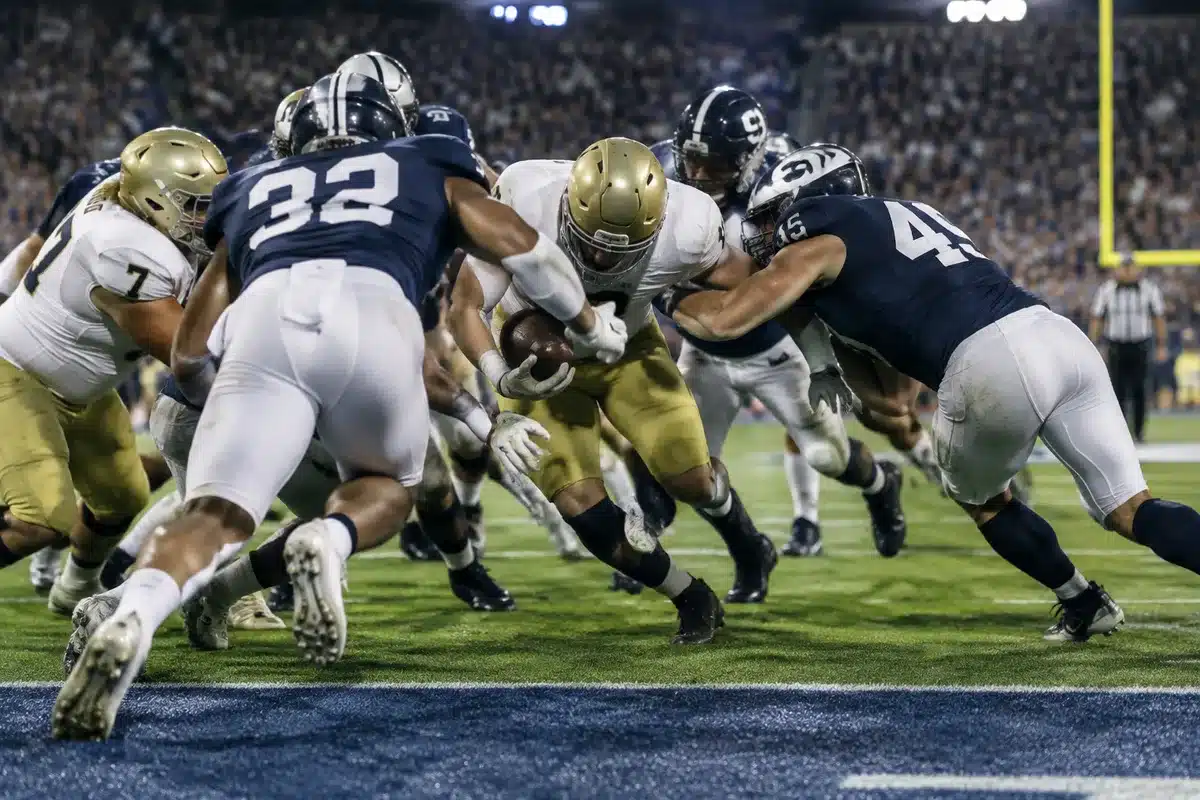
Ohio State surrendered a 14-0 lead and lost 41-28 to No. 23 Oregon, a defeat that followed a 30-18 loss to USC the previous week. The back-to-back regular-season losses mark the program’s first such stretch since November 2011 and have dramatically dimmed its playoff outlook.

The Buckeyes slid to No. 21 in Sunday’s AP poll, the program’s lowest position since the College Football Playoff era began. That placement also makes Ohio State the first AP preseason No. 1 team to fall outside the top 20 during the regular season since USC in 2012.
Michigan and Ohio State struggling despite high spending
Wisconsin defense graded by position after win over USC
Ryan Day acknowledged the unexpected turn after the Oregon game. “We didn’t expect any of this to happen,” he said. “Two weeks in a row, to get this kind of result, there’s something that needs to change and needs to get fixed.”
Meanwhile, Michigan’s struggles continued with a 15-6 loss to rival Michigan State, which had been without a Big Ten victory entering the game. The defeat deepened pressure on first-year head coach Kyle Whittingham, who described his reaction bluntly after the game.
“I’m as disappointed as I’ve ever been as a head coach and as frustrated as I’ve been as a head coach tonight,” Whittingham said.
Big spending, meager returns
The setbacks have intensified scrutiny over heavy investments in staff and operations. Michigan assembled the highest-paid coordinator pairing in the sport this season, a combined $5.7 million split between offensive coordinator Jason Beck ($3 million) and defensive coordinator Jay Hill ($2.7 million).

On Sunday Michigan fired Beck. The program’s offense has struggled this year, ranking near the bottom nationally in both scoring and total yards.
Ohio State also ranks near the top of Big Ten spending. The Buckeyes reported $92,359,308 in football operations expenses for fiscal year 2025, the largest total in the conference. Michigan sits fifth on that list at $61,663,185.
Coaching salaries at Ohio State are similarly notable: defensive coordinator Matt Patricia is listed as the highest-paid coordinator in the country at $3.75 million, while offensive coordinator Arthur Smith earns $1.5 million. The roster itself has been valued around $50 million, according to the figures cited.
Former Buckeye standout Curtis Samuel voiced fan frustration after the loss to Oregon. “Can’t allow a team to come in the shoe and be the bully,” he said. “That’s unacceptable and for sure not the culture.”
Quarterback issues and injuries
Injuries and uneven quarterback play have been central to both teams’ woes. Ohio State’s starter, Julian Sayin, a Heisman finalist the previous season, is likely lost for the year after suffering an arm injury against Indiana on Oct. 17. True freshman Luke Fahey has started in his place, producing mixed results; two of the program’s three lowest scoring outputs this season came under Fahey.
“I think the kid’s trying his tail off,” Day said, defending the freshman. “It’s a tough spot to be in for a true freshman. But the expectation is to come in and play and win.”
Michigan’s offense has also been hampered by instability at quarterback. Former No. 1 overall recruit Bryce Underwood was benched in October in favor of true freshman Tommy Carr. Since taking over on Oct. 17, Carr has accounted for five total touchdowns.
Whittingham did not sugarcoat the program’s direction. “There’s nothing productive about this game,” he said. “It’s not one step back; it’s three steps back.”
Recent form, conference context
Across the last 11 games — stretching back to the final weekend of the 2025 regular season — both Ohio State and Michigan sit in the lower half of Big Ten teams by win-loss record, according to the span cited. Only a handful of conference teams have performed worse in that stretch: Nebraska, Michigan State, Maryland, Purdue and Rutgers.
Coaching contracts and potential fallout
Both head coaches are on multi-year, high-value deals that complicate any decision-making. Whittingham signed a five-year, $41 million contract last December; it carries a 75% buyout, quoted at roughly $24.6 million if he were dismissed after one season. He expressed cautious optimism about recruiting and roster building despite the setbacks.
“When you look down the road, the recruiting class we put together for the 2027 class, we feel really good about,” Whittingham said. He added that the upcoming transfer portal window will be another avenue to add depth.
Day’s contract runs seven years through 2031 at an average value reported as $12.5 million per year, signed after Ohio State’s 2024 title season. The potential buyout has been estimated around $75 million, which would rank among the largest in college football history.
“I’ve got to evaluate everything and try to come in and figure out with the staff the things that we’re just coming up short on and figure out how to adjust those things,” Day said. “There needs to be accountability for all of it, and then we go from there.”